At the same time, citizens trust the authorities but are afraid to publicly criticize them
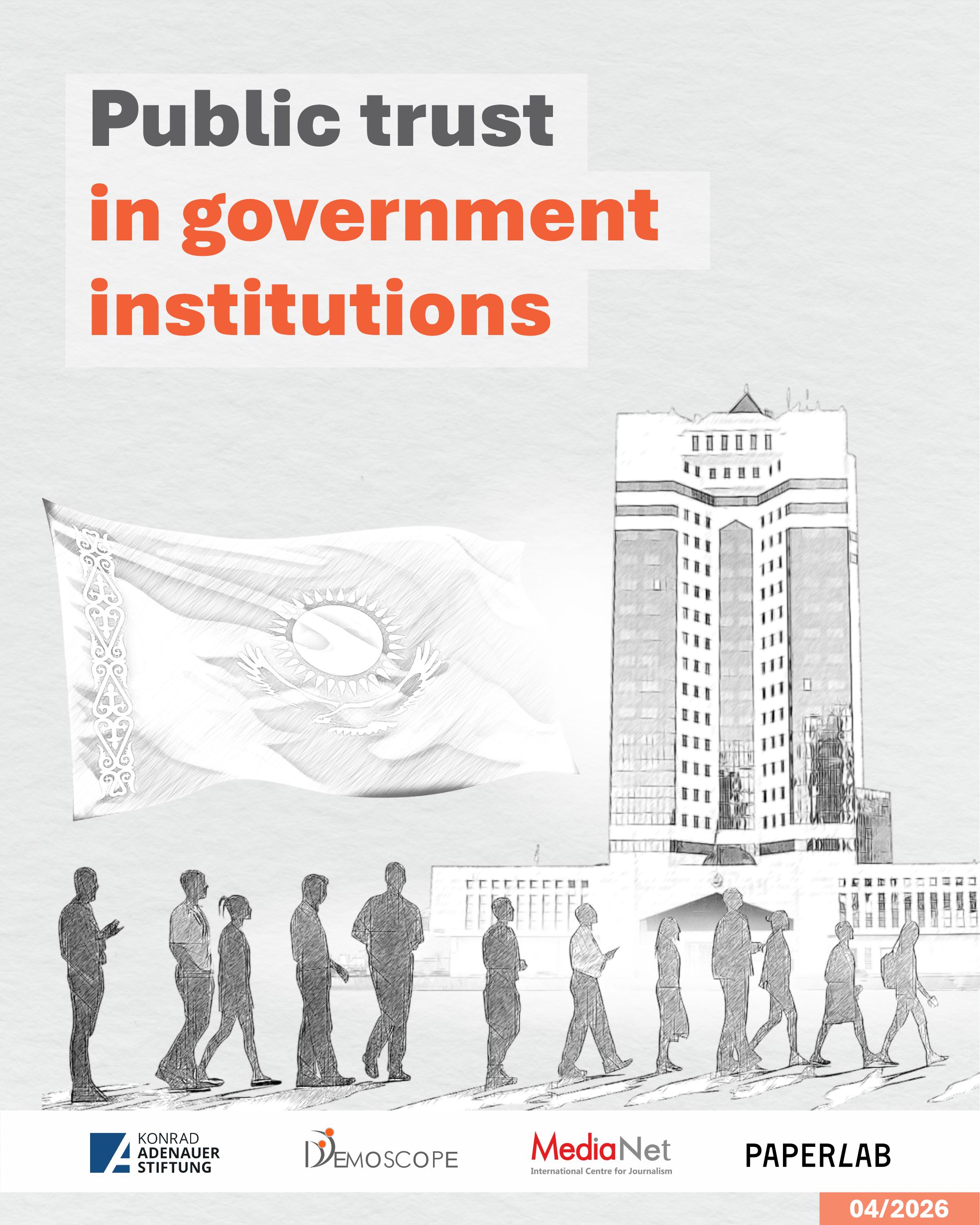
From February 24 to March 6, 2026, the DEMOSCOPE Express Public Opinion Monitoring Bureau conducted a survey of citizens on the topic “Public Trust in Government Institutions.” The project is implemented by MediaNet International Center for Journalism in cooperation with the PAPERLAB Research Center and with the support of Konrad Adenauer Foundation.
The DEMOSCOPE study revealed a contradictory but stable public trend – alongside a relatively stable level of trust in state institutions, a pronounced demand for deep and systemic changes has formed in society.
According to the survey data, an absolute majority of citizens – 85.4% – believe that the country needs change. Notably, in this question the dominant share consists of those who expect large-scale and decisive reforms – 71.6%, while another 13.8% believe that minor changes are sufficient. Only 10.7% of respondents believe that the country does not need change and prefer to keep things as they are.
The DEMOSCOPE Bureau conducted a similar survey in December 2023, when the demand for change was even higher – a total of 89.9%.
At the same time, the results demonstrate relatively stable trust in government authorities over the past 12 months. For half of the respondents (50.3%), the level of trust has not changed. For 23.4% of respondents, the level of trust has increased, while 19.7% reported a decline in trust.
The survey showed that the highest level of public support is enjoyed by the President of the country – 61.3%. At the same time, 17% of citizens expressed distrust in the President. Compared to December 2023, the level of loyalty to the head of state has decreased – at that time it stood at 69.4%.
Second in the public trust ranking are local executive bodies (akimats), which are trusted by half of the respondents (50.2%), while about one-third (29.8%) expressed distrust.
The Government of the Republic of Kazakhstan is rather trusted by 47.4% and rather not trusted by 27.7%. Next in the ranking are law enforcement agencies: 46.8% trust the security structures and 32.5% do not trust them. The lowest level of trust is recorded in relation to Parliament and the judicial system – 40.5% and 43.7% trust them, respectively. Whereas 31.2% and 30.6% express distrust.
Analysis by age shows a significant gap. The core of support is primarily formed by young people aged 18–29, while the lowest level of trust is observed among citizens aged 50–59. Thus, among respondents aged 18–29, 72.5% and 59.4% tend to trust the President and the Government, respectively. Among citizens aged 50–59, these figures are 51.2% and 35.4%, respectively.
It is also noteworthy that a significant share of respondents – from 20% to 28% – found it difficult to answer questions about trust in government authorities. Such a level of uncertainty may indicate the sensitivity of the topic and self-censorship.
Another important indicator of the political landscape is the ability of citizens to openly express criticism of the authorities. DEMOSCOPE data show that fear of public expression prevails in society – more than half of Kazakhstanis (56.1%) are afraid to openly criticize the actions of the authorities on the internet, considering it unsafe. Of these, 28.5% are convinced that speaking out is categorically dangerous, and another 27.6% fear that criticism may lead to pressure or legal proceedings.
At the same time, another 14.4% allow for the possibility of criticism, but in a careful manner and without naming individuals. Only 9.8% believe that expressing opinions about state bodies is completely safe. This question also proved to be sensitive for 19.7% of respondents, who found it difficult to answer.
A key result of the study is the relationship between fear of public criticism and the level of trust in government institutions. The analysis shows that the higher the level of fear of criticizing the authorities, the lower the level of public trust in them. Thus, among respondents who believe that criticizing the authorities is completely safe, the level of trust in the President reaches 83.2%, compared to an average value of 61.1%. Among those who consider criticism categorically dangerous, the level of trust in the President is significantly lower and stands at 56.1%.
A similar pattern is observed with regard to the Government of Kazakhstan. In the group with a high assessment of the safety of criticism, trust reaches 70.8%, compared to an average level of 47.4%. Among respondents who consider criticism categorically dangerous, the indicator drops to 41.9%.
The survey also examined citizens’ ability to influence government decision-making. The results showed a split in public opinion – 47% of Kazakhstanis believe that ordinary citizens do not have a real influence on government decisions. At the same time, 46.3% are convinced that they are able to influence such decisions.
An age gap is also evident in this issue. The greatest enthusiasm is observed among respondents aged 18–29 – 56.1% believe that their voice will be taken into account in the decision-making process, while in the older age group (50–59) this figure is significantly lower at 39.4%.
To assess social optimism, survey participants were asked whether Kazakhstan is developing in the right or wrong direction. 44.6% of Kazakhstanis believe that the country is moving in the right direction, and another 27.8% believe it is rather moving in the right direction. In total, 18.7% oppose this view, believing that the country’s development trajectory is incorrect.
In 2022, the President of Kazakhstan announced a course toward building a “Just Kazakhstan.” According to 55.6% of respondents, this concept corresponds to the real actions of the authorities. The opposite view is held by 33.8%, who believe that the current reality is not just.
The DEMOSCOPE results demonstrate a persistent paradox – alongside a stable level of trust in government institutions in Kazakhstan, a high and largely unmet public demand for serious reforms has formed. This fact indicates that trust is rather conditional in nature and does not eliminate the need for substantial changes.
At the same time, a significant share of Kazakhstanis who experience fear of publicly criticizing the authorities suggests risks to the sustainability of this trust in the long term. Given the current economic challenges, rising prices, and declining household incomes, the government should take effective measures to protect and improve citizens’ quality of life in order to transform public expectations and trust into real change.
Detailed survey results are available on the project website. The press release and infographics in Kazakh and Russian are available via the link. When using the material, a hyperlink to the DEMOSCOPE website is mandatory.
Methodology: From February 24 to March 6, 2026, 1,100 people were surveyed across 17 regions and cities of republican significance (Astana, Almaty, and Shymkent). The survey was conducted via telephone interviews among mobile subscribers in Kazakhstan. The sample was based on a database of phone numbers generated using a random number generator. The telephone survey was carried out by KT CloudLab Contact Center. The survey included 47.4% men and 52.6% women aged 18 and above. 65.8% preferred to respond in Kazakh, 34.2% in Russian. 76% of respondents are Kazakh, 12.2% are Russian, and 11.3% represent other ethnicities. 68.4% of respondents live in urban areas, and 31.4% in rural areas. The data are weighted by parameters such as gender and age of respondents. The maximum margin of error at a 95% confidence level does not exceed 3%. The response rate was 10.5%. The survey was implemented by MediaNet International Center for Journalism Public Foundation with the support of Konrad Adenauer Foundation. The survey data reflect the views of the respondents. For additional information please contact Snezhana Tsoy, snezhana.tsoy@medianet.ngo.