Kazakhstanis Name the Key Events and Challenges of the Outgoing Year
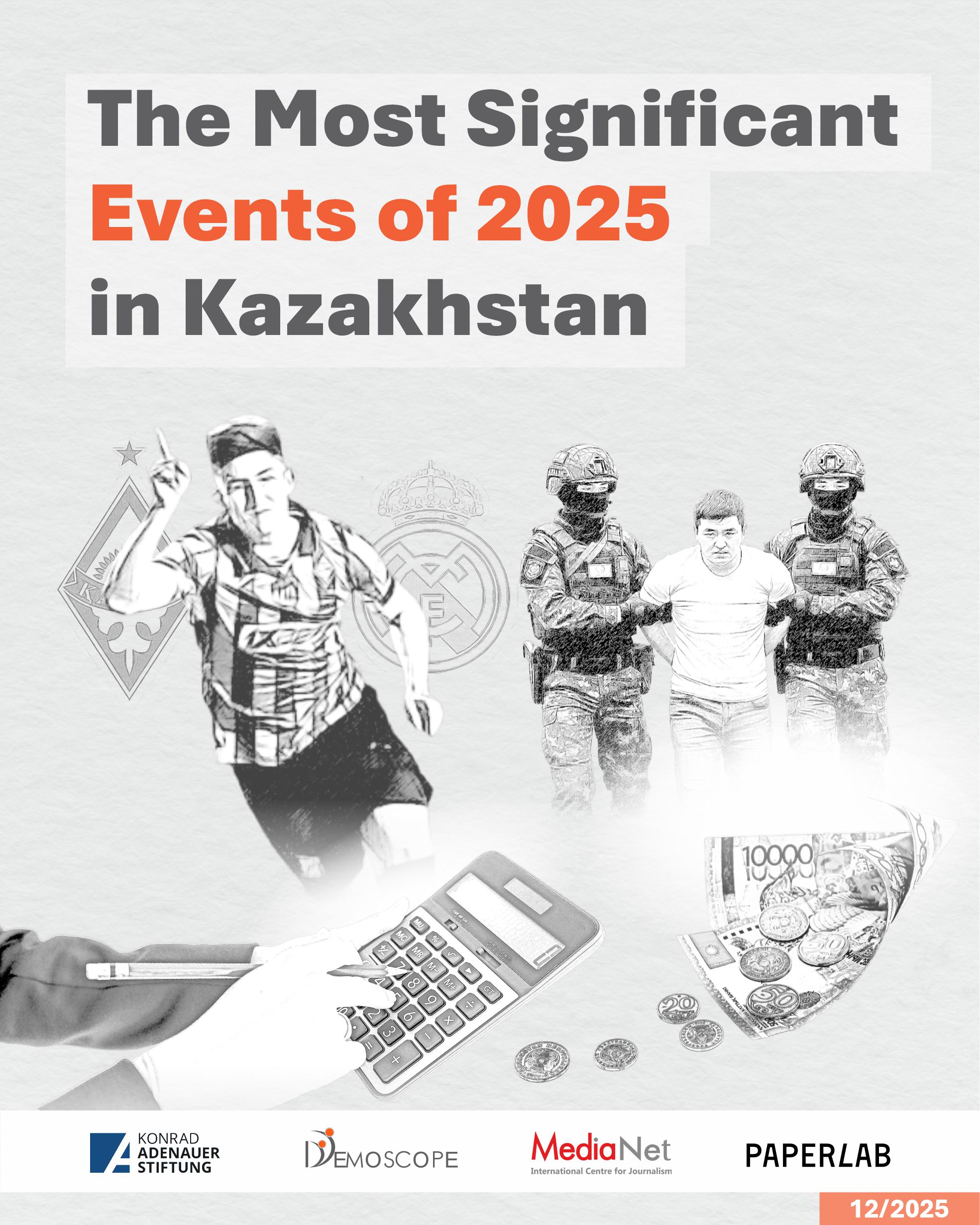
From 25 November to 5 December 2025, the DEMOSCOPE Public Opinion Express Monitoring Bureau conducted a public survey titled “The Most Significant Events of 2025 in Kazakhstan.”
The project is implemented by MediaNet International Center for Journalism in cooperation with the PAPERLAB Research Center, with the support of Konrad Adenauer Foundation.
According to DEMOSCOPE survey data, the outgoing year has been challenging for many people in Kazakhstan. The findings indicate a high level of public anxiety, a skeptical perception of government reforms, and a low level of trust in the government.
Notably, for the second year in a row, the shortlist of the most pressing issues of public concern has remained unchanged. However, compared to last year, a negative trend is evident.
The DEMOSCOPE survey shows that in 2025 the main concerns for Kazakhstanis were:
- Low income – 40.9% (37.6% in 2024)
- Rising prices for basic goods – 35.6% (28.3% in 2024)
- Corruption – 32% (26.8% in 2024)
Other major issues identified in 2025 include:
- Unsatisfactory healthcare system (26.8%)
- Environmental pollution (24.4%)
- Low levels of pensions, social benefits, and scholarships (23.9%)
- Lack of affordable housing or poor housing conditions (23%)
- Unsatisfactory education system (18.4%)
- Shortage of jobs and difficulties with employment (17.4%)
- Poor transport infrastructure (roads, sidewalks, etc.) (11.7%)
At the same time, 11.9% of respondents reported that they were not concerned about anything. Respondents were allowed to select up to five answer options for this question.
An illustrative indicator of public sentiment is the list of the most significant events of the outgoing year in Kazakhstan. As is tradition in DEMOSCOPE’s annual survey, respondents were asked to name the most relevant events – both negative and positive – from any sphere of public life.
According to respondents, the top five most significant events of the year were:
- FC Kairat qualifying for the UEFA Champions League and its match against Real Madrid in Almaty – 10.8%;
- Rising prices and inflation – 8.1%;
- Personal circumstances – 5.5%;
- Sporting achievements (including the election of Gennady Golovkin as President of World Boxing, the victory of tennis player Elena Rybakina at the WTA Finals, and others) – 4.5%;
- Crime and incidents of violence – 3.6%.
For 30.6% of respondents, nothing particularly significant happened during the year. Another 13.7% mentioned other events, while 25.1% found it difficult to answer. Respondents were allowed to select up to three answer options for this question.
As part of the 2025 end-of-year survey, respondents were also traditionally asked to provide a separate assessment of government initiatives. In particular, they were asked about President Kassym-Jomart Tokayev’s proposal to abolish the Senate and introduce a unicameral Parliament. According to the survey results, 40.4% support the proposal, 30.2% had not heard about it, 13.4% expressed indifference, and 5.5% do not support the idea.
According to sociologist Serik Beisembayev, Director of the research center Paperlab, the 40% level of support for a unicameral parliament should not be interpreted as evidence of a broad public demand for constitutional reform.
“What we are observing here is the effect of paternalism and a high degree of personalization of power. I believe the wording ‘the President proposed’ played a key role – in such cases, a legitimacy transfer mechanism is triggered, whereby support for the leader as a person is automatically converted into approval of their initiatives. Tokayev has a loyal audience, and it is most likely this group that responded positively to the proposal.
The survey analysis shows that the core of support comes from the 60+ age group (47%), which retains the inertia of Soviet-era loyalty, while young people aged 18–29 demonstrate extremely low awareness: more than 40% in this group reported that they had ‘not heard anything’ about the initiative,” the expert noted.
Survey participants were also asked to assess a controversial proposal voiced by a member of the Mazhilis – to legalize polygamy in Kazakhstan. Critical attitudes clearly prevail on this issue: a majority of citizens (64.2%) opposed the initiative. At the same time, the prospect of legalizing polygamy was supported by 13.9% of respondents.
Notably, responses to this question show a clear gender-based correlation. Support for polygamy among men (23.1%) is four times higher than among women (5.5%). Conversely, 80.2% of women and 46.5% of men expressed opposition to the proposal.
It should be recalled that respondents had previously expressed their views on other government initiatives as well. In November 2024, citizens assessed the introduction of a single time zone (53.1% opposed), and in April 2025, the tax reform (52.8% opposed).
The DEMOSCOPE Bureau also asked Kazakhstanis to evaluate the state of key social sectors in the country using a three-option scale: improved, worsened, or remained unchanged.
For the third consecutive year, environmental issues top the list of areas perceived as having deteriorated: 49.4% of respondents believe the situation has worsened. A decline in quality of life was reported by 41.9%. This is followed by the economy, with 39.1% indicating regression in this sphere. Employment and job opportunities also received a negative assessment (35%).
At the same time, there are areas where positive assessments outweigh negative ones. Nearly one third of respondents believe that the education system (31.7%) and the sphere of law, order, and public safety (31.7%) have improved.
According to the majority of respondents, the situation in healthcare (42.5%) and in the area of political and civil freedoms (34.4%) has remained unchanged.
Paradoxically, despite the perceived deterioration in several key areas of life, most Kazakhstanis remain optimistic. In total, 62.6% believe that the outgoing year, 2025, was positive for them personally. Of these, 31.7% consider 2025 to have been rather positive, while 30.9% describe it as very positive. Only 12.2% report that the year was negative.
Optimism also prevails in expectations for 2026. A total of 65.5% believe that the coming year will be better than the outgoing one. At the same time, 12.1% are pessimistic, and 12% expect the new year to be roughly the same as 2025.
Annual nationwide surveys conducted by the DEMOSCOPE Bureau over the past three years indicate a crisis of public trust in many state initiatives. This, in turn, hinders the effective implementation of public policy and reduces citizens’ engagement in strategically important initiatives.
To overcome this crisis, the authorities should adapt national policies to better reflect public demand for systemic change – by strengthening anti-corruption measures, enhancing social protection in the context of economic challenges, and increasing transparency in public administration processes.
Detailed survey results are available on the project website. The press release and infographics in Kazakh and Russian are accessible via the link. When using these materials, a hyperlink to the DEMOSCOPE website is mandatory.
________________________________________________________________
Methodology: From 25 November to 5 December 2025, a total of 1,100 respondents were surveyed across 17 regions and cities of republican significance (Astana, Almaty, and Shymkent). The survey was conducted via telephone interviews among mobile phone users in Kazakhstan. The sampling frame was based on a database of phone numbers generated using a random number generator.
The telephone survey was administered by the LLP CloudLab Contact Center. The sample included 47.4% men and 52.6% women aged 18 and older. A majority of respondents (67.8%) chose to complete the survey in Kazakh, while 32.2% preferred Russian. Ethnically, 77% of respondents identified as Kazakh, 11.5% as Russian, and 11% as representatives of other ethnic groups. In terms of residence, 69% of respondents live in urban areas, while 30.9% reside in rural areas.
The data were weighted by key parameters, including respondents’ gender and age. With a confidence level of 95%, the maximum margin of error does not exceed 3%. The response rate was 10%.
The survey was implemented by MediaNet International Center for Journalism Public Foundation with the support of Konrad Adenauer Foundation. The survey data reflect the views of the respondents.