But the “language issue” is perceived differently by speakers of various linguistic groups.
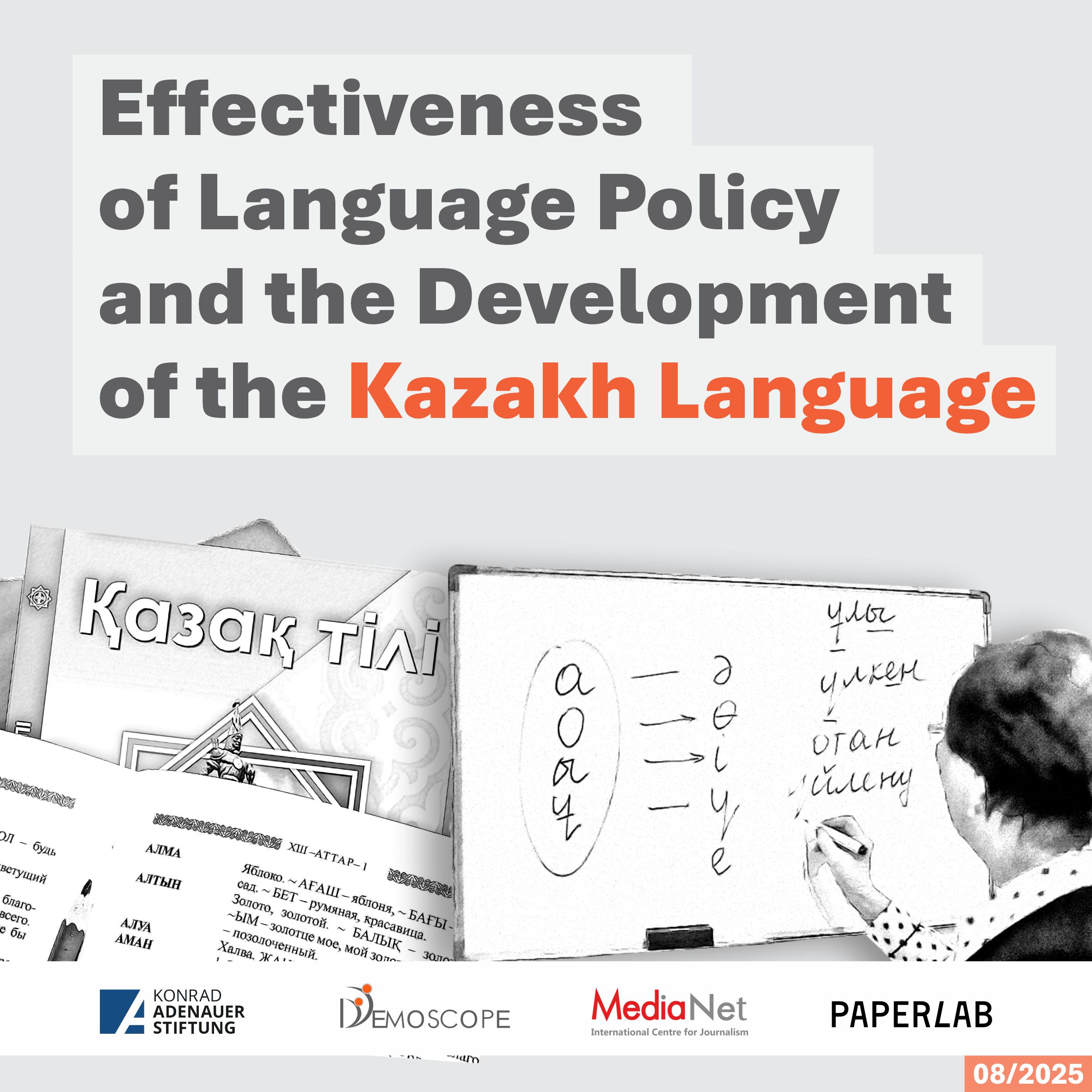
From July 24 to August 9, 2025, the DEMOSCOPE Public Opinion Express Monitoring Bureau conducted a survey on the topic “Effectiveness of Language Policy and the Development of the Kazakh Language.” The project is implemented by MediaNet International Center for Journalism in cooperation with PAPERLAB Research Center and with the support of Konrad Adenauer Foundation.
When assessing the most appropriate language policy, Kazakhstanis’ opinions were almost evenly divided: one in three respondents (33.8%) support linguistic diversity with equal rights for all language groups; nearly a third (30.8%) favor the active development of Kazakh while preserving the role of Russian and English; and 29.5% support prioritizing the development and promotion of the Kazakh language.
It is noteworthy that in terms of a key marker – the demand for a language in career and professional activities – Kazakh leads. The overwhelming majority of citizens (80.1%) noted its importance. More than a third of respondents (35.5%) consider Russian important, while 23.8% highlighted English. (Note: for this question, respondents could select one or two options.)
Participants were asked to evaluate the effectiveness of state policy on the development of the Kazakh language on a five-point scale, where 5 means “very effective” and 1 “completely ineffective.” The DEMOSCOPE survey shows that almost half of respondents (47.2%) consider the current language strategy very effective, and 18.2% somewhat effective. At the same time, a total of 28.5% of Kazakhstanis view the current policy on the development of the state language as ineffective. Of these, 4.5% rate it as completely ineffective, and 24% as insufficiently effective.
A correlation emerges in this question depending on the language of communication. Dissatisfaction with the effectiveness of Kazakh language policy is most pronounced among Russian-speaking respondents (33.6%). Among bilingual respondents (Kazakh and Russian), 24.1% expressed dissatisfaction. The lowest level of dissatisfaction is observed among Kazakh-speaking respondents – 19.4%.
Until recently, the main linguistic concept in Kazakhstan was the trilingualism program, first announced in 2006 by former president Nursultan Nazarbayev. The program envisaged a strategy of society’s mastery of Kazakh (as the state language), Russian (as the language of interethnic communication), and English (as the language of integration into the global economy).
The results of implementing this three-dimensional language model over almost 20 years can hardly be described as successful or as a daily benchmark for the majority of Kazakhstanis. Nevertheless, half of respondents (50.7%) still consider the idea of trilingualism very relevant for Kazakhstan. Another 32.8% regard it as somewhat relevant, while only 12.7% find it somewhat irrelevant or entirely irrelevant.
At the same time, one of the main objectives of state language policy is recognized as strengthening the status of the Kazakh language and creating conditions for its development. During the survey, citizens identified barriers that hinder its development (multiple answers were allowed):
- Lack of qualified teachers (26.4%)
- Low motivation of the population to learn Kazakh (23.9%)
- Shortage of quality textbooks and language centers (21.5%)
- Ineffective teaching methods (16.3%)
- Kazakhstan’s involvement in the Russian information space (15.7%)
- Corruption in the implementation of language policy (12.2%)
- Limited scope of language use (9.2%)
- No barriers at all (17.4%).
Interestingly, perceptions of problems in the development of the state language also show a marked contrast depending on respondents’ language of response. In particular, almost twice as many Russian-speaking (34.1%) and bilingual (32.4%) respondents noted the lack of qualified teachers, compared to Kazakh speakers (18.1%).
Conversely, the issue of Kazakhstan’s involvement in the Russian information space was identified by 19.4% of Kazakh speakers, 14.7% of bilingual respondents, and only 8.4% of Russian speakers.
Respondents also identified measures they consider effective for developing the Kazakh language (multiple answers were allowed):
- Improving the quality of teaching in schools and universities (39.8%)
- Stricter language requirements for government officials and service organizations (26.6%)
- Free courses for adults (25.3%)
- Support for public initiatives promoting the state language (21.1%)
- Promotion of Kazakh through cinema, music, and media (19%)
- Anti-corruption checks of state programs for learning Kazakh (15%)
- Translation of fiction and specialized literature into Kazakh (11%).
The DEMOSCOPE Bureau also explored which language, in respondents’ opinion, provides the highest quality education in Kazakhstan. Most respondents (37.7%) believe it is Kazakh. One-fifth (23.3%) believe the quality is higher in Russian, and 4% in English. Meanwhile, 27.9% believe that the quality of education does not depend on the language of instruction.
Again, a correlation was observed depending on respondents’ language. Among Kazakh speakers, 53.5% believe education quality is higher in the state language, while only 7.9% in this group consider Russian-language education higher quality. Conversely, 45.3% of Russian speakers believe education is better in Russian, while only 13.3% say Kazakh. Among bilingual respondents, one-third (33.5%) believe Russian-language education is better, while a quarter (25.9%) favor Kazakh.
The possibility of learning Kazakh in adulthood is another important aspect of the “language issue.” Survey results indirectly indicate a lack of public infrastructure and effective teaching methods, highlighting the need to audit existing adult learning models in line with successful international practices.
According to the survey, about half of respondents (49.9%) have never encountered individuals who learned Kazakh after the age of 18. At the same time, 33.5% know only a few such cases, while 15.5% noted that they had encountered many.
The survey results predictably demonstrated differences in perceptions and assessments of the “language issue” depending on respondents’ language, as well as priority challenges and directions for addressing pressing problems.
Note: In some questions, respondents could select multiple answers. Detailed survey results are available on the project’s website. The press release and infographics in Kazakh and Russian are available via the link. When using this material, a hyperlink to the DEMOSCOPE website is required.
Methodology: From July 24 to August 9, 2025, 1,100 people were surveyed across 17 regions and cities of republican significance (Astana, Almaty, and Shymkent). The survey was conducted through telephone interviews with mobile subscribers in Kazakhstan. The sample was based on randomly generated phone numbers. The telephone survey was carried out by the call center of KT CloudLab LLP. Respondents included 47.4% men and 52.6% women aged 18 and older. Of these, 68.6% chose to answer in Kazakh, and 31.4% in Russian. By ethnicity: 78.5% Kazakhs, 10.4% Russians, and 10.7% other nationalities. By residence: 66.9% urban, 32.7% rural. Data were weighted by gender and age of respondents. With a 95% confidence level, the maximum margin of error does not exceed 3%. The response rate was 9.3%. The survey was conducted by MediaNet International Center for Journalism Public Foundation with the support of Konrad Adenauer Foundation. The data reflect the opinions of respondents. For more information, please contact the coordinator Snezhana Tsoy: snezhana.tsoy@medianet.ngo.